Small groups, always
Four divers to a guide, and fewer than that on a course. It is the single thing that decides whether a dive is a tour you were on or a dive you actually did.
A small dive centre on Havelock Island, run by people who dive these reefs on their days off. This is how we work, and what we will not compromise on.
Aqua Nomad started with one boat, two instructors and a compressor that had to be talked into starting. Fifteen seasons later the kit is better and the boat leaves on time, but the reason any of it exists has not moved: the Andamans are one of the few places left where a first-time diver and a hundred-dive diver can be genuinely astonished on the same afternoon.
We are a teaching centre before we are a tour operator. Instructors here are in the water with you, not counting heads from the surface, and the ratios are deliberately smaller than the standards require - because the difference between a dive you survived and a dive you understood is almost entirely how much attention there was to go round.
The rest is unglamorous and matters more: regulators serviced on schedule, cylinders in test, briefings that name the depth limit and the turn-around point out loud, and a willingness to call a dive off when the water says so.


PADI sets the minimum a dive centre has to meet. It is a good minimum and we hold it on every dive - and on the things that decide how a day actually goes, we work well inside it.

Every dive centre says it is safe and friendly. These are the four that actually cost us something, which is the only reason they are worth printing.
Four divers to a guide, and fewer than that on a course. It is the single thing that decides whether a dive is a tour you were on or a dive you actually did.
If the swell is wrong or the visibility has gone, we move the site or we call the day. No boat has ever left this jetty to protect a timetable.
No gloves, no touching, nothing fed. Buoyancy is briefed before anyone gets in, because the sites we dive have to still be worth diving in ten years.
Regulators serviced on schedule and cylinders in test. Every set is laid out, fitted and checked with you on dry land before it goes on your back.
Paperwork and the medical declaration first, then kit fitted and logged on dry land. Nothing about your first descent should be a surprise.
The site, the plan, the depth limit, the hand signals and the turn-around point - said out loud, before the engine goes on.
Buddy checks at the surface, then a guide in the water alongside you for the whole dive. Not watching from the boat.
What you saw, what to work on next time, and the dive signed into your log before the tanks come off the boat.
Best first dive I could have asked for. The instructors were unbelievably patient - I panicked at four metres on the first attempt and nobody made me feel stupid about it. Second attempt went fine and I finished the course three days later.
Only one of us dives. Every other operator we spoke to had a plan where the other one sat on a beach for four days. Aqua Nomads put the snorkel line off the same boat, so we were in the same water the whole week - and by day three I had done a Discover Scuba dive too. The sunset sailing on the last evening was the best hour of the trip.
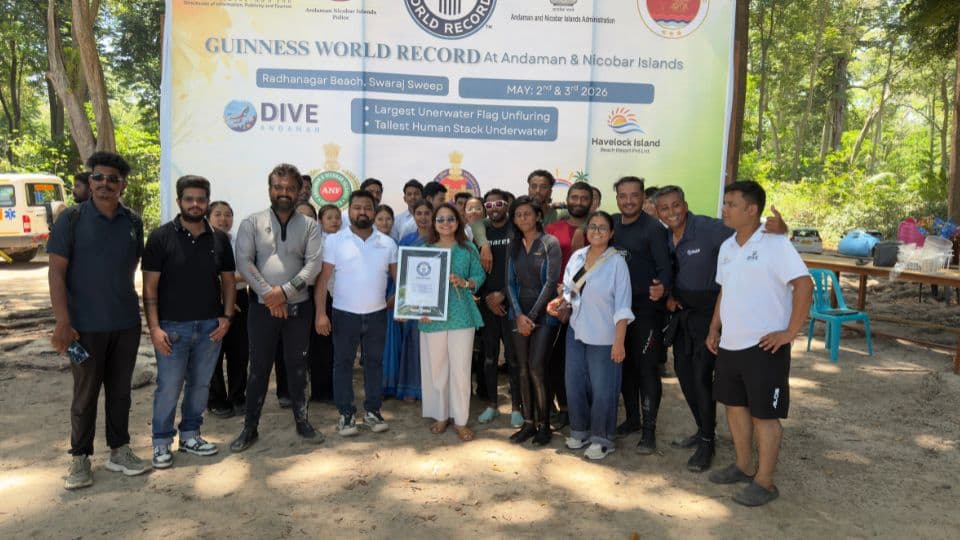 Priya and Arjun NairHoneymoon, February
They called the Dixon crossing on our first morning because of a swell, and I was quietly annoyed. We dived Jackson Bar twice instead and it turned out to be the best day of the week. Getting Dixon on day three in flat water made the point - they were right and I was wrong.
Two teenagers, neither of whom had dived. The instructors worked one-to-one with both of them for the first two dives without us asking, and my daughter has since booked her Open Water for next December. Whatever they did, it worked.
I cannot swim well and I said so when I booked. They ran the whole thing one instructor to one diver, stayed in the shallow half of the bay, and never once made it feel like a concession. I have since done the swim assessment and the full course.